

France welcomes 412,000 foreign students (around 14% of students), according to Campus France figures for 2025, an increase of 17% since 2019. France is the 6th most popular country behind USA, UK, Australia, Germany, Canada.
Some websites to find general information about French higher education:
- The ONISEP website (in French)
- The French student portal (in French)
- Campus France is the official online portal run by the French government that assists students in their university applications, from choosing a university up to visa processing (in English).
Compared to other countries, France has a complex system of higher education. The French higher education system is made up of several different types of establishment, which may be in either the public or the private sector.
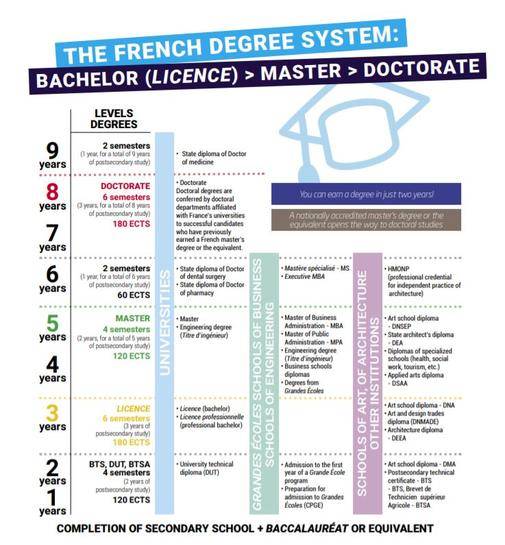
The French degree system: Bachelor (Licence), Master, Doctorate.
Source: CAMPUS FRANCE : www.campusfrance.org/en/French-degrees-LMD-equivalences
- LONG PROGRAMS
- SHORT PROGRAMS
- FEES AND SCHOLARSHIPS
- STUDENT LIFE
- LEARN FRENCH
- USEFUL WEBSITES
Compared to other countries, France has a complex system of higher education. The French higher education system is made up of several different types of establishment, which may be in either the public or the private sector:
- The universities
- The “grandes écoles” post graduate schools
- The specialized schools (“écoles spécialisées”)
Universities
Degrees: Courses are based on three levels:
- Licence (Bachelor’s degree) – 180 ECTS
- Master (Master’s degree) – 120 ECTS
- Doctorat (Doctoral degree)
Academic year: The academic year is split into 2 semesters, the first one from September to December and the second one from January to June.
Courses/programs 5 big domains:
- Art – Humanities –Language (design, applied foreign languages, humanities, music…).
- Law – economy – management – political and social sciences (economic and social administration, law, journalism, management, political sciences…).
- Human and social sciences (philosophy, psychology, geography, history, art history, sport sciences, theology…).
- Science, technology (chemistry, physics, engineering sciences, life sciences, mathematics, earth and environment…).
- Health (dental, physiotherapy, maieutics, medicine, orthoptics, pharmacy).
For more information on public Universities. For more information about programs. Finding a «Llicence » (Bachelor) program. Finding a Master program. Finding a Doctoral program.
Some courses are taught in English for example in Political science, business, sciences, hostel management, aerospace, engineering, multimedia, economics etc. For more information.
Les Grandes écoles – Post graduate schools
Presentation
The “Grandes écoles” or post-graduate schools offer five-year courses, which usually include two years of initial preparation in the post-graduate school itself or in preparatory classes offered by secondary schools. These preparatory classes (Classes Préparatoires aux Grandes Ecoles, CPGE) or « prépa » prepare students over a two-year period to take the entrance examinations for one or more « grandes écoles ». However many schools today offer alternative admission procedures, which allow international students to apply at different stages of their academic careers.
The Grandes écoles are very selective. Degree programs in the Grandes écoles usually include international internships and study abroad.
For more information : “Conference des Grandes écoles”: to have information about schools, admissions…
State recognition of the institution and the degree:- For engineering schools, this recognition is granted following a review by the Commission on Engineering Degrees (CTI).
- For management schools, following a review by the Management Training and Qualifications Assessment Committee (CEFDG).
The « Classes préparatoires aux Grandes écoles »
Two years courses following the “Baccalauréat” (end of secondary school exam) usually dispensed in an high school and preparing students for the competitive entrance examination to the Grandes Ecoles. CPGEs are highly selective, at the application and during the courses themselves. For more information (in French).
« Engineering schools »
Around 200 regulated « schools » offer courses leading to a degree in engineering, including for some components of universities. These schools prepare to the “Diplome d’ingénieur” (engineering degree). This is a national diploma that is equivalent to a Master’s and entitles its holder to apply to a Doctoral program.
Management and business schools
Many management/business schools exist today, with around 85 of these institutions recognised by the French state. Many are private institutions. Annual tuition fees average is 16 848€ by year but for the more high ranked, it’s more than 50 000€. They are turned to the world with a large number of Franco-foreign programs and campuses based abroad.
Ecoles Normales Supérieures (ENS)
The ENS offer four high-level year of education in cultural and scientific training programs for students who would like to pursue fundamental or applied scientific research, university teaching or, more generally, civil-service careers in the public administrations.
There are 4 ENS:
- ENS Paris Ulm: main studies literature and languages, exact sciences, humanities and social sciences, law, theory of art.
- ENS Lyon: main studies humanities and social sciences, exact sciences.
- ENS Cachan: main studies exact sciences, humanities and social sciences, languages.
- ENS Rennes: main studies in law and economics, exact sciences, sport.
Institute of political studies (Institut d’études politiques IEP)
- Science po Paris (in English)
- IEP d’Aix-en-Provence (in English)
- IEP de Bordeaux (in English, Spanish, gGrman, Italian, Russian, Japanese, Chinese)
- IEP de Fontainebleau
- IEP de Grenoble (in English and Spanish)
- IEP de Lille
- IEP de Lyon
- IEP de Rennes (in English)
- IEP Saint-Germain-en-Laye
- IEP de Strasbourg (in English)
- IEP de Toulouse (in English)
Others “Grandes écoles”
- Ecole Nationale des Chartes: specialized in humanities and social sciences and particulary in history.
- INSP (ex ENA)– Institut national du service public : the INSP, France’s top institution for the training of future senior civil servants (hauts fonctionnaires), top politicians and managers.
- CELSA (Centre d’Études Littéraires et Scientifiques Appliquées) is a school specialised in journalism, communication, marketing, advertising, and medias.
- Veterinary school, 4 schools in France: VetAgro Sup (Lyon), ENVA (Maison-Alfort), Nantes ONIRIS (Nantes) and ENVT (Toulouse). 5 years of school after a competitive examination open after 2 years of higher education.
Specialised schools
There are a lot of schools often called “écoles spécialisées” in several domains such health, paramedical studies, multimedia, communication, journalism, social work, fashion, design, tourism, culinary arts, hotel management and agriculture.
Culinary arts
- Ecole Lenôtre
- Ecole Ducasse
- Ecole Le Cordon bleu
- Ferrandi : l’école française de gastronomie
- Institut Lyfe, anciennement Paul Bocuse, in Lyon but French gastronomy is dynamic, highly inventive and constantly evolving under the influence of new Chefs.
Schools of Arts
Campus Art : a Campus France portal specialized in Arts studies.
Schools of Architecture
20 Écoles Nationales Supérieures d’Architecture (ENSA), public schools under the ministry of Culture and Communication provide national regulated degrees. Some of them are associated to official engineering schools and have an authorisation to deliver a double degree ‘architect-engineer’: link.
Law
All legal careers teaching institute are opened to students who already have an undergraduate or postgraduate diploma in law (at the University) after a competitive examination.
- Lawyer: competition opened after a M1 in law (but 80% has a M2), 18 month in one of the 12 centers “CRFPA”.
- Bailiff: competition opened after a M1 in law. 2 years in the “Ecole Nationale de droit et de procédure” (ENADEP).
- Magistrate: competition opened after a M1 in law, 31 months in the “Ecole Nationale de Magistrature (ENM)”.
Health
High school students can enter maieutics, medicine, odontology or pharmacy after one, two or three years of higher education, or continue on to a Bachelor’s degree. Two types of pathway are offered by the universities: a specific access to health pathway (PASS), a Licence with an access to health option (L.AS). The L.AS are years of Bachelor’s degree containing mainly courses corresponding to the chosen discipline (e.g. Law, Biology, Maths, Humanities, etc.) supplemented by courses linked to the « health » option, which provide the skills necessary to pursue studies in health (courses in fundamental sciences and human and social sciences relevant to the field of health), English courses, modules for discovering the health professions, and preparation for the exams enabling students to apply for a job in the health sector. If they pass their first year of the licence, they can, if they wish, apply for the health study(s) they are interested in (maieutics, medicine, odontology or pharmacy). If they are not admitted to these courses, they can continue in the second year of their licence and, if they wish, reapply for health studies after at least one additional year (in L2 or L3 for example). If they do not validate their first year of the licence, they cannot apply for health studies. They can repeat this first year or reorient themselves towards other higher studies. The PASS is a specific Bachelor’s year comprising mainly « health » courses supplemented by non-health subjects (Law, Biology, Maths, Humanities, etc. for at least 10 ECTS credits), English courses, modules to discover the health professions, and preparation for the exams to apply for health studies. If they pass their first year, they apply for the health studies that interest them (maieutics, medicine, dentistry or pharmacy). If they are not accepted, they can continue in the second year of the degree corresponding to their option and, if they wish, reapply for health studies after at least one additional year (in L2 or L3 for example). If they do not validate their first year, they cannot apply for health studies or repeat this year. They must reorient themselves via Parcoursup if they wish to pursue other higher education studies. Generally speaking, students have two chances to apply for health studies (maieutics, medicine, dentistry, pharmacy) throughout their first cycle. More information in the Campus France website : Health studies in France.- Medecine: 9 to 11 years
- Dental surgery: 6 to 8 years
- Pharmacy: 6 to 9 years
- Midwifery / maieutics: 5 years
Sciences
Choose France for science : for the reception of international researchersParamedical
In order to go to paramedical schools you have to succeed a competitive examination. Some doesn’t require the “Baccalauréat” as auxiliary nurse competition or child care assistant competition and some does as nurses, orthoptists, speech therapist, psychomotor therapist…


